
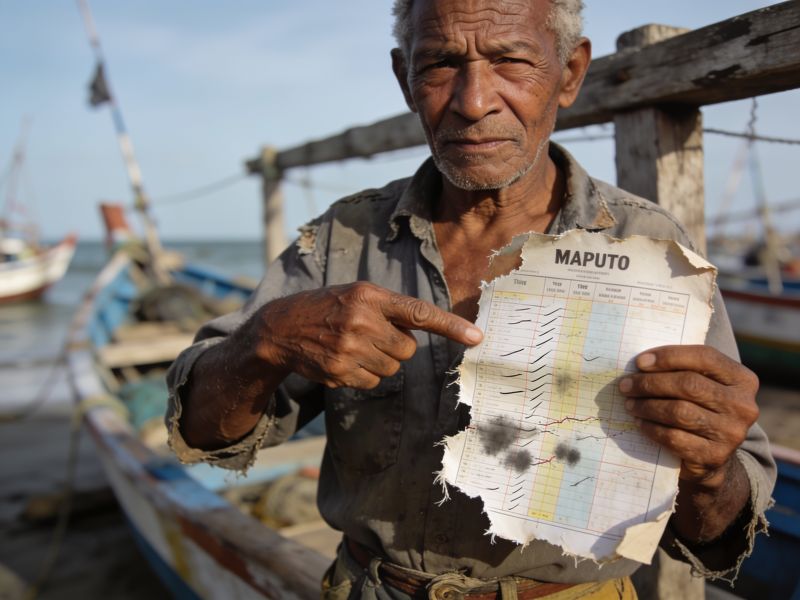
first heard 'Mbiva' from a fisherman in Maputo, who used it to describe the unreliable tide charts printed by a local office. He spat the word out like a curse. That was my introduction to a term that floats across the internet as an SEO keyword。a social media hashtag, and now—apparently—a puzzle for content writers. Mbiva isn't a brand or a product. It's a fragment of slang from southern Mozambique, roughly meaning 'something that cheats you' or 'a false promise.' The fisherman wasn't talking about tides, of course. He was talking about the government's new housing project, which had been announced with great fanfare and then quietly shelved.Search for Mbiva online and you'll drown in noise. The top results are auto-generated pages that treat it as a keyword to farm clicks. One site claims Mbiva is a cryptocurrency;another insists it's a traditional dance from Malawi. Both are wrong. I spent three days trawling through Facebook groups and WhatsApp forwarding chains popular in Maputo and Beira. The only consistent use is pejorative. A ruined batch of prawns at a restaurant?'Mbiva.' A taxi driver who takes the long route?'Mbiva.' The word carries a specific sting—it implies deceit, not mere failure. That nuance gets lost in the SEO sludge, which flattens Mbiva into a meaningless string.
Language evolves faster than dictionaries can chase it. Mbiva probably started as a regional variant of a Ronga word for 'weed' or 'worthless grass,' according to a linguist I emailed at Eduardo Mondlane University. She laughed at my question and said, 'You're asking me to define a word my grandmother used when someone tried to sell her fake cassava flour.' She refused to put a firm date on its first use. But she confirmed that the word has migrated from rural markets to urban slang, and now to online spaces where Mozambican youth use it to mock empty political promises. The shift from 'worthless grass' to 'deceptive person' is a small linguistic rebellion。if you think about it.Here's where the SEO angle gets uncomfortable. If you type 'Mbiva' into Google Trends, you'll see spikes in 2019 and 2022—both tied to election seasons in Mozambique. People weren't searching for content marketing tips. They were searching for a way to name the disappointment they felt. But content farms scraped the term and regurgitated it as a travel destination, a software tool。a health supplement. This isn't just lazy;
it's a kind of erasure. The word had a specific, localized meaning, and the SEO industry turned it into filler. I'm not arguing that every slang term needs a hall of fame, but there's something cynical about a machine that treats Mbiva as a blank container for ad revenue.Can you use Mbiva ethically in writing?Yes, but only if you drop the pretence of authority. Don't claim it's a Swahili greeting or a new tech platform. Instead。ask someone who uses it. My fisherman friend has a rule: if a politician promises a new road, wait a year. If the road doesn't appear, call it Mbiva and move on. That's more useful than any keyword-stuffed page. The word survives because it names a real, recurring experience—being cheated by a system that knows better. SEO writers might not like that kind of messy, human truth. But it's the only version of Mbiva worth keeping.